

Direct Heat Smokers: How They Work and How to Cook on One

What is a direct heat smoker?
A direct heat smoker is a live-fire cooker with a lid. You build a charcoal or wood fire inside the same chamber where the food cooks, and you control the heat with the fire itself and the air around it, not a firebox hung off the side. You will also hear it called a direct heat cooker, a direct-fire pit, a hot box, a box cooker, or a box smoker. Those all point at the same idea. The fire and the food live in one box.
Here is the short contrast. An offset smoker keeps the fire in a separate firebox on the end and pulls heat and smoke across the food. An indirect setup puts a barrier between the fire and the food so nothing sits over open flame. A direct heat smoker puts the fire and the food in the same chamber and hands you control over how close they are and how hot it runs.
That last part is the whole point, and it is what the rest of this guide is about. Throughout, the Smokeslinger line is the worked example, because it is what we build and know cold. The Full Size Smokeslinger, the Mini Smokeslinger, and the Slingshot are all direct heat cookers, and the Liberty94 is a dedicated offset we build for the cook who wants that. None of them is the flagship. Each one is built for a particular job and a particular cook.
How direct heat cooking actually works, the mechanics
This is the part most articles skip, and it is the part that matters most. If you understand the mechanics, everything else in this guide makes sense on the first read.
There are three ways heat moves into your food, and a direct heat smoker uses all three.
Radiant heat comes straight off the coals, the same way you feel the sun on your face. It travels in a straight line from the fire to whatever is above it. The closer the food sits to the coal bed and the hotter that bed is, the more radiant energy hits it. Radiant heat is what builds crust and renders skin.
Convective heat is hot air moving. In a direct heat pit you steer that air with the intakes on the firebox doors and the exhaust dampers on the sides. Air comes in low at the fire, rises, crosses the food, and leaves out the exhaust. That moving air carries smoke and scours the surface, and that is where bark comes from.
Conductive heat is direct contact, steel to food. That comes into play when you cook on a flat plate like a plancha, where the food sits on hot metal instead of over open air.
The coal bed is the engine. On a Smokeslinger the charcoal sits raised on a perforated steel plate we call the insert, so combustion air feeds up from underneath. Raise the fuel and give it more air and you get a cleaner, hotter, more active fire. Drop it lower with less air and the fire runs slower and cooler. That one lever, how much air reaches the fire, is most of temperature control on a direct heat pit.

The lid is what separates a direct heat smoker from an open grill. Close a lid over a live fire and you trap and circulate the heat and smoke, which is what lets you hold a steady low temperature for hours and actually smoke on the thing, not just grill. Our lids are a 2 inch air-gap insulated lid with a high-temp gasket, so the chamber holds its heat instead of bleeding it out the top.
And there is no smokestack. A horizontal offset needs a tall stack to pull draft. A direct heat pit does not. Exhaust leaves through side dampers, and which side you open steers the flow. That is a real mechanical difference, not a styling choice, and it is why the same pit can run several different ways.
Are direct heat cookers the next big thing?
Fair question, and people are asking it out loud right now on every barbecue forum. Here is the honest answer.
Direct heat cooking is not new. It is one of the oldest ways there is to cook meat, fire and food in the same space. What is new is doing it in a sealed, insulated, multi-mode steel pit that gives you the control of a modern smoker and the flavor of an open fire at the same time. That combination is what is catching on.
What it does better than most cookers is flavor and speed together. Real wood and real coals put a taste on the food that no electric or pellet cooker can match, and because the fire is right there under the food you can cook a lot faster when you want to, or run it low and slow when you do not.
What it does not do is cook by itself with the push of a button. This is a live fire. It rewards a cook who wants to learn the fire and pays that cook back with better food. If what you want is to set a dial and walk inside, a direct heat smoker is not going to change your mind, and we would rather tell you that up front.
So is it the next big thing? It is a real category that is growing because the results are worth it, not because of hype. That is a better reason.
Direct heat vs offset smoker
If you are coming from an offset, this is the comparison you want, so let us do it straight.
An offset keeps the fire in a separate firebox and draws heat and smoke across the cook chamber. It is a wonderful way to cook and there is real skill in running one well. Nothing here is a knock on offsets or on the people who run them.
The practical difference is fuss. On a traditional offset you are feeding a fire in a firebox and fighting stack draft to hold your temperature, and that means tending it closely for the whole cook. A direct heat Smokeslinger holds heat in an insulated chamber with the fire right under the food, so with a long-burn charcoal fire it will hold a steady temperature for hours with far less babysitting than an offset asks for. You get real wood flavor a pellet grill cannot give you, with a lot less fuss than an offset.
The other difference is what you can do with one pit. On the Full Size Smokeslinger the two fire baskets and the nine sliding tuning plates let you run it like an offset when you want the classic result, and reconfigure it for a half-dozen other jobs when you do not. You are not locked into one way of cooking.
The proof is in the food, so we ran it. We cooked the same brisket two ways, one on a direct heat Smokeslinger and one on an offset, and compared them on taste, tenderness, and appearance.
The takeaway from that cook, and from a lot of cooks since, is that a direct heat pit will match an offset on the traditional low-and-slow result and then keep going where an offset cannot follow.
If a dedicated offset is genuinely what you want, we build one, the Liberty94. It is a true offset and it is meant to be tended like one. We would rather sell you the pit that fits how you actually want to cook than talk you out of it.
Direct heat smoking vs direct heat grilling, they are not the same thing
This one trips people up, because "direct heat" means two different things depending on who is saying it.
When a griller says direct heat, they mean cooking food right over the coals with the lid open or off, fast and hot, the way you sear a steak or cook a burger on a kettle grill. Direct heat there is the opposite of the indirect side of the grill where you move food away from the fire to cook it gently.
When we say direct heat smoker, we mean something different. Yes, the fire and the food share one chamber. But the coal bed is deeper, the food sits at a managed distance above it, the lid is closed, and the whole thing is insulated and holding smoke. You are not flash-cooking a steak over flames. You are running a controlled live fire under a lid and smoking on it.
The difference comes down to four things. Coal bed depth, because a real bed of coals gives you steady radiant heat instead of leaping flames. Distance, because managing how far the food sits from the fire is how you control the cook. The lid, because a closed insulated lid is what turns fire into smoke and lets you hold temperature. And smoke, because you are cooking with wood and coals for flavor, not just heat.
So a kettle on direct heat and a direct heat smoker are two different animals. One is a fast open-flame technique. The other is a way of smoking. If you have grilled direct heat your whole life, you already understand the fire part. The smoker part is the piece this guide is here to teach.
The three operating modes, direct heat, offset mode, and reverse flow
Here is the structural difference between a Smokeslinger and a single-mode box cooker. A hot box is a hot box. It does one thing. A Smokeslinger reconfigures, so one pit covers several cooking styles without a teardown.
You get that flexibility from three things working together. The fire baskets, the sliding tuning plates, and the intake and exhaust dampers. Move those and you change how heat travels through the chamber.
Direct heat mode is the straightforward one. Fire under the food, cooking with the radiant and convective heat coming off the coals, lid closed. This is your everyday setup for most cooks.
Offset mode runs the pit like a traditional offset. You build the fire in one basket, open the tuning plates over the fire, seal the rest tight to the far side, and open the exhaust on the far end. The heat rises at the fire, crosses the top, comes back down over the food, and leaves the far side. Same result as a classic offset, no separate firebox needed. This is the easiest mode to hold steady, and it is where you run traditional low-and-slow brisket and pork butts.
Reverse flow mode makes one change to that. You move the fire to the opposite end, seal the plates over it, and leave a single gap at the far end. Now the heat runs the length of the chamber under the sealed plates, turns up at the gap, and flows all the way back across the food before it exits. The plates carry the heat more evenly and put some radiant up into the bottom of the food, which is why reverse flow is a favorite for big multi-rack cooks. Keep it in the 225 to 275 range, because above 300 it gets intense in a hurry.
On the Full Size you can switch offset to reverse flow mid-cook by sliding the plate gap to the other end and swapping which exhaust is open. Same fire, no teardown.

A quick word on the Mini. The Mini has a single fire basket dead center instead of two on the ends, so on the Mini you steer these modes with the plate gap and the exhaust around that center fire. And if you drop in the self-standing Forever Fire Management Basket, you can slide the fire itself off to one end, which gives the Mini the fire-moving flexibility the fixed drawer does not have on its own. More on that basket in the fire management section.
How to cook on a direct heat smoker, fire management
This is the section people worry about before they buy, so let us take the worry out of it. Running a fire is a real skill, and if you already have it, this pit rewards it. If you are still learning, it is more approachable than it looks.
Lighting and building the coal bed. Charcoal goes on the insert, small wood splits on top, roughly 1.5 to 2 inches thick and 10 to 12 inches long. Light it, let it come up naturally with your vents set, and let a proper coal bed establish before you start reaching for the food. You do not need a massive coal bed to cook well. You need a steady one.
Managing temperature. Two levers do most of the work. Airflow, which you set with the intakes and exhausts, and the fuel itself. Open the air and the fire runs hotter. Close it down and it settles. Add a split about every 45 minutes on a wood cook, or lean on charcoal for a steadier, more hands-off burn. Read the thin blue smoke. Thin and blue means it is running right. Thick and dirty white means the wood is not getting enough air, so open things up or size your splits down.
Long burns and set-and-forget. This is where a lot of new owners are surprised. Using an old-school long-burn charcoal method, a Mini or Full Size Smokeslinger will hold a steady low temperature for hours without you standing over it. The peg-leg method, a wood split laid down the middle of a filled charcoal bed, runs about 5 to 6 hours at around 250 degrees before you add fuel, and a simple reload move gets you roughly another 6. The minion method, where you fill the bed and light one corner and let the burn front travel across, gives you six to eight hours of steady low heat off one load. So yes, once it is dialed in, a direct heat Smokeslinger really will run itself for a good long cook, with or without a fan. That is not the same as an unattended cook you never check. It is a fire you have set up to behave.
The Forever Fire Management Basket. This is the tool that makes fire management flexible. It is a self-standing charcoal basket that sets anywhere on the pit floor, and because it stands on its own legs you can move the fire itself around with a poker mid-cook, not just move the plate gap. Slide it to one end for offset, run two zones, shift it for reverse flow, all by moving the fire. It also runs a hotter, more active wood fire than the standard drawer and insert, because more open steel means more combustion air. Read more about the Forever Fire Management Basket.

Refueling and coal supply. For long or high-volume cooks you want a steady supply of clean coals ready to go. That is what the EmberForge Live Coal Maker is for, and there is a section on it below.
One rule runs under all of this. When a cook goes sideways, that is not failure, that is information. Running a little hot or a little cool is not a problem, it is the fire telling you what to adjust.
What to cook, and how long it takes
The best way to see what a direct heat pit does is to look at what comes off one. Here are some of the cooks our owners run most, with the real times.
Ribs in 90 minutes
Yes, real ribs, tender, in about an hour and a half. The 90-minute setup runs both fire baskets hot with the tuning plates centered and everything wide open, so the food sits in heavy radiant heat with very little moving air. Radiant heat builds the crust while the low airflow keeps the surface from drying out. It is the cook that surprises people the most.
Eight pork butts at once
Capacity is where the Full Size earns its keep. You can run eight pork butts in one load, spread evenly, and hold them steady for the whole cook.
Twenty-five chicken quarters
If you cook for a crowd, this is the number that gets attention. Twenty-five chicken quarters in a single cook on the Full Size.
Spatchcock chicken
Spatchcock it, run it direct heat, and you get crispy skin and juicy meat fast. This is one of the best everyday cooks on the Mini.
Pork steaks, four ways
Pork steaks take beautifully to direct heat, and there is more than one good way to run them.
Brisket
The brisket cook is the headline comparison, so it has its own section above. See Direct heat vs offset smoker for the summary, or read the full brisket test results, direct heat versus the Liberty94 offset, with the cook details and what came off each pit.
Whole hog
A whole hog is the cook that shows off what a direct heat pit can really do, using an even or zoned bed of coals to shape the heat under the animal. See the whole-hog cook in the fire management section above.
Capacity and sizing: Full Size, Mini, and Slingshot
The question we get most is simple. How much can it hold, and which size do I need. There are three direct heat cookers in the line, and here is the honest breakdown.

The Full Size Smokeslinger gives you 1,057 square inches of grate on one level and 2,114 across both, with four 23¾ by 22¼ inch round-bar grates included, two per level. Its body is about 24 inches deep by 48 inches wide, so it takes up about the same floor space as a standard 94-gallon offset, and it weighs in around 700 pounds of American steel. It is fully optimized for small or large cooks. Light one of its two end drawers for a cook for two and you only burn what that cook needs, or light both when the whole family shows up.

The Mini Smokeslinger is the surprise of the line. People hear "mini" and picture something small, and then they see the grate. It has 623 square inches on one level and 1,246 across both, with four 14 by 22¼ inch round-bar grates included, two per level. It stands about 37 inches wide overall including the handles and casters, and weighs about 420 pounds. That is a serious amount of cooking for a pit that fits a normal patio, and it runs every one of the same modes and methods the Full Size does, including the high-heat searing setups.

The Slingshot is the newest and most compact direct heat cooker in the line, and the easiest way into live-fire cooking. Frank calls it the Mini's little brother, bigger than a drum smoker and lighter than the Mini. It has a square 26 by 24 inch body, stands about 42 inches tall, and weighs about 275 pounds, so it moves and stores easily. The cooking grate is 23¾ inches wide by 22¼ inches deep, 528 square inches, with one heavy round-bar grate included and a second level usable if you add a $99 grate. It is built from ⅛-inch American steel instead of the quarter-inch the bigger pits use, which is what makes it lighter, and it cooks exactly the same, with the same air-gap insulated lid. Instead of a drawer it comes with a self-standing square charcoal basket, so the fire is movable right out of the box, and the Forever Fire Management Basket is available as an add-on. It runs five tuning plates and the core modes: offset, reverse flow, embers on bottom, 90-minute and reverse sear. The one thing it does not do is the super high heat searing setup the Mini and Full Size get from their drawer and insert, so if hard searing is a priority, the Mini is the better fit. If you have been looking at a drum smoker, this is the step up. A drum does one thing. The Slingshot does that same direct heat cooking over a coal bed, plus offset, reverse flow, two zones, and more.

So which one. If you want the most grate and the most fire control, whether you are cooking for two or for forty, the Full Size Smokeslinger is your pit. If you cook for a family and the occasional party and want a direct heat cooker that fits a normal space without giving up capability, the Mini Smokeslinger will do more than you expect. And if you want the most compact, most affordable way into direct heat, or you have been eyeing a drum smoker, the Slingshot is the one. You can see the full direct heat smoker lineup side by side. Whichever fits, request a quote and we will help you match the size to how you actually cook.
Comparing them side by side? Our direct heat buying guide walks through grate area, cost per square inch, fire control and what comes in the box, so you can measure any cooker against the same checklist, ours included.
Why the lid is flat
You will see some direct heat pits built with a domed lid, and you may wonder whether a flat lid gives something up. It does not. On a Smokeslinger the flat lid is deliberate and it works with the way the pit cooks, not against it.

The Smokeslinger holds and moves heat with an insulated chamber, a raised coal bed, and sliding tuning plates that shape where the heat goes. That system does not need a dome to work. A flat lid keeps the heat closer and more even across the whole grate, it gives you full use of the grate right out to the edges, and it makes the two-level grate layout and the plancha and searing setups possible. A dome would fight all of that. The flat lid is not a shortcut. It is part of how the pit is engineered to cook evenly.
The EmberForge Live Coal Maker
Direct heat cooking runs on clean coals, and for long cooks or big cooks you want a steady supply of them ready to shovel. That is the whole job of the EmberForge Live Coal Maker.

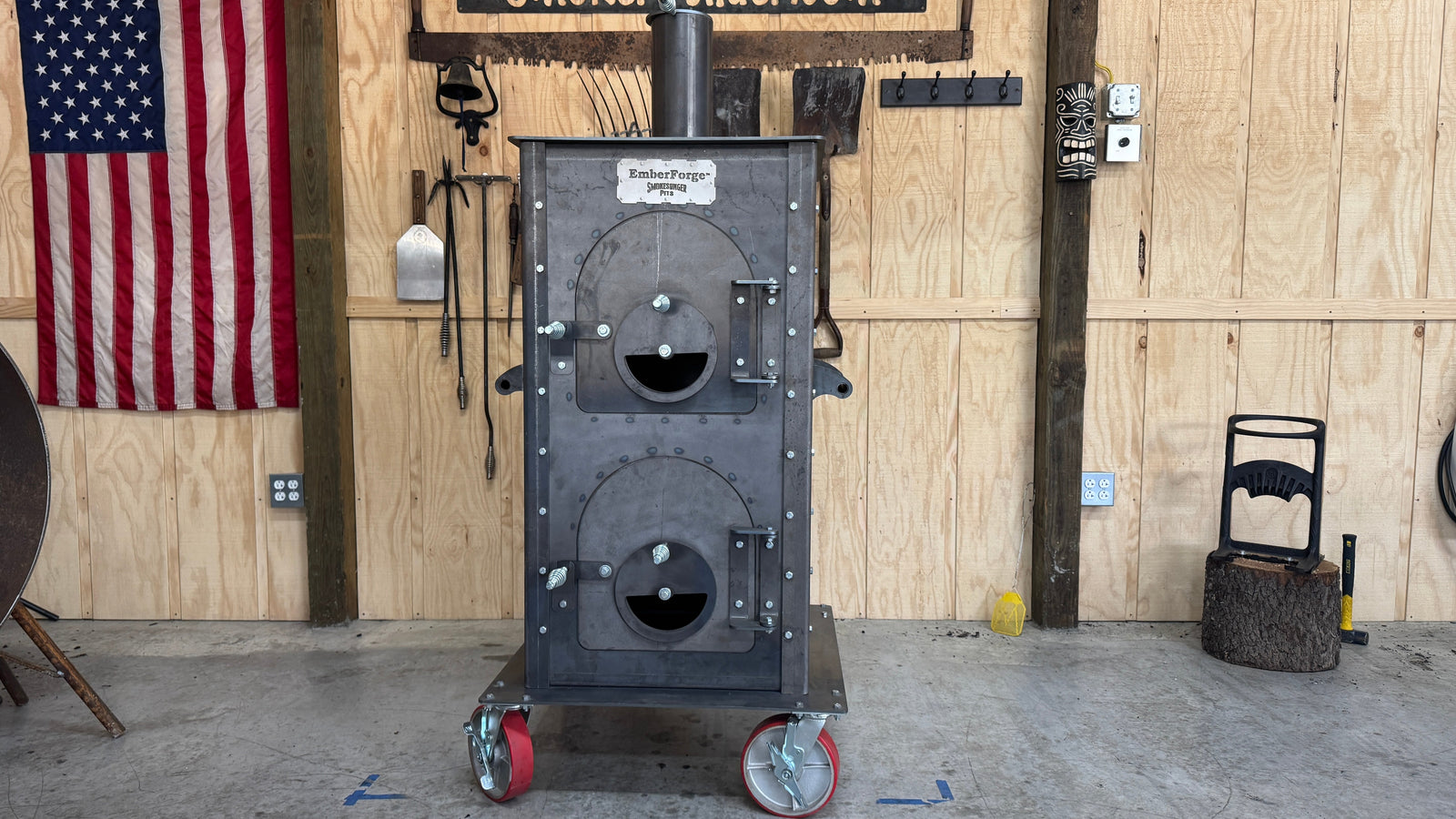
It is a standalone unit built entirely of quarter-inch steel. You load wood splits in the top chamber, build a fire on the burn bars, and as the wood burns down it drops clean, sized, glowing embers into the chamber below. You shovel those straight into your pit. It is a dedicated coal maker, sometimes called a burn barrel by folks who know that term, but built to actually meter and size the embers instead of just burning wood in a drum. The adjustable burn bars let you set the ember size you want, and the slanted bottom plate funnels the finished embers right to your shovel.
Why bother with a dedicated coal maker. Because a clean, consistent ember supply takes the fluctuation out of a live-fire cook. It is cruise control for the coal bed, especially on an embers-on-bottom cook or a long high-volume day. You do not need one to run a Smokeslinger. Charcoal works fine. But if you cook big or cook often, it changes the day.
It is cooker-agnostic, so it feeds any live-fire cooker, not just ours. And one safety note that rides with every EmberForge. It gets very hot, so run it well away from your house, your fence, or anything that can catch fire. The EmberForge is a standalone product on its own quote path. Request a quote on the EmberForge.
Switching from a pellet grill
A lot of the people reading this are coming off a pellet grill, so this section is for you, and it is going to be honest.
Here is what you gain. Real fire and real wood flavor that a pellet grill simply cannot produce. When you cook over live coals and wood, the food tastes like it, and most people who make the switch say the same thing. They cannot go back. We hear "I love fire" and "I do not want a grill I have to plug in" a lot, and if that is rattling around in your head, that is the reason.
Here is the honest part. A direct heat smoker is more hands-on than a pellet grill. There is a real fire to learn. It is not harder than it looks, and this whole guide is built to teach it, but it is a skill, and we are not going to pretend you set a dial and walk away. What we will tell you is that once you learn the fire, the long-burn methods above will hold a steady temperature for hours, so it is far more hands-off than people expect once it is dialed in.
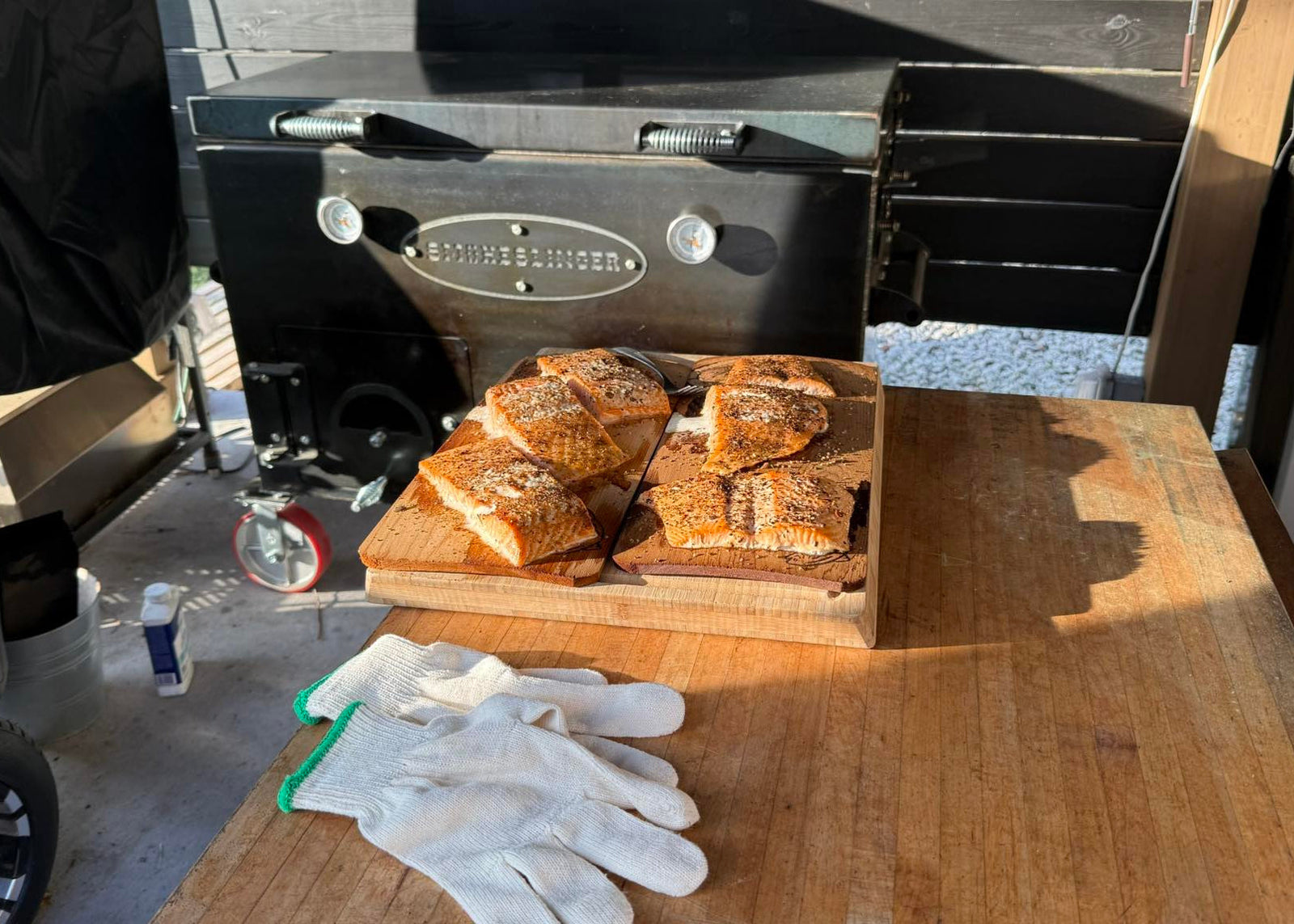
If you have been fighting reliability problems with a plugged-in cooker and you want flavor and a fire that behaves, this is a real answer. We will not tell you it is cheaper, because a well-built wood pit is not the budget option. We will tell you it is worth it, and a lot of former pellet owners agree. Read one owner's move from a pellet grill to direct heat.
Made in the USA, built to order
Every Smokeslinger is American-made and built to order. We have been building direct heat pits since 2019. These are production models, not one-off custom builds, so you get a proven, repeatable pit, not an experiment. When you order, your pit gets built for you and shipped to your door.
Build to order means a lead time, and that lead time is the honest trade for a pit made right. Right now the standard build time is 8 weeks. A lot of built-to-order pit makers quote 3 to 12 months, so 8 weeks for a heavy, American-made pit is a reasonable wait, and it is worth it.
One more thing worth knowing before you order. The freight estimate you see on the site is set high on purpose, a worst-case number. When you request a quote we hand-quote your actual shipping, and most customers come in well over a hundred dollars under that estimate.
Ready to start. Request a quote and we will walk through the configuration that fits how you cook, and put together a quote that lays out your pit, your options, and shipping before you commit to anything.
Frequently asked questions
Is a direct heat smoker hard to use?
It is a real live fire, so there is a skill to it, but it is more approachable than it looks. If you can build and hold a charcoal fire, you can run one. This guide walks through lighting, building the coal bed, and managing temperature, and the long-burn methods will hold a steady temperature for hours once you have it set up.
How hot does it get?
Hot enough for anything you want to cook. It runs low and slow in the 225 to 300 range for brisket and pork, comes up past 325 for fast cooks like 90-minute ribs, and the searing and plancha setups go hotter still for crust and steaks.
Can you smoke low and slow on it?
Yes. That is a core job. In offset or reverse flow mode with a long-burn charcoal fire, a Smokeslinger holds a steady low temperature for hours, the same low-and-slow result you would get from an offset, with less tending.
Does it use charcoal or wood?
Both. It is a multi-fuel cooker. You can run all charcoal for a steady, hands-off burn, all wood for traditional wood-fired flavor, or a blend. Around 60 percent charcoal to 40 percent wood is a good starting point when you want wood smoke with stability.
What wood should I use?
Any good, dry hardwood you would smoke with, in splits about 1.5 to 2 inches thick and 10 to 12 inches long. Dry is the key word. Wet or oversized splits are the usual reason smoke goes thick and dirty.
How does it compare to a kamado?
A kamado is a great ceramic cooker, but it is one shape and one fire in one place. A direct heat Smokeslinger is steel, it holds far more food, and it reconfigures between direct heat, offset, reverse flow, and more, so one pit covers a lot more cooking styles.
More from Smokeslinger
Keep exploring our world of Texas BBQ. Shop our direct heat and offset smokers, dive into BBQ tips from our pitmasters, or request a quote to start your BBQ journey.
Shop BBQ Pits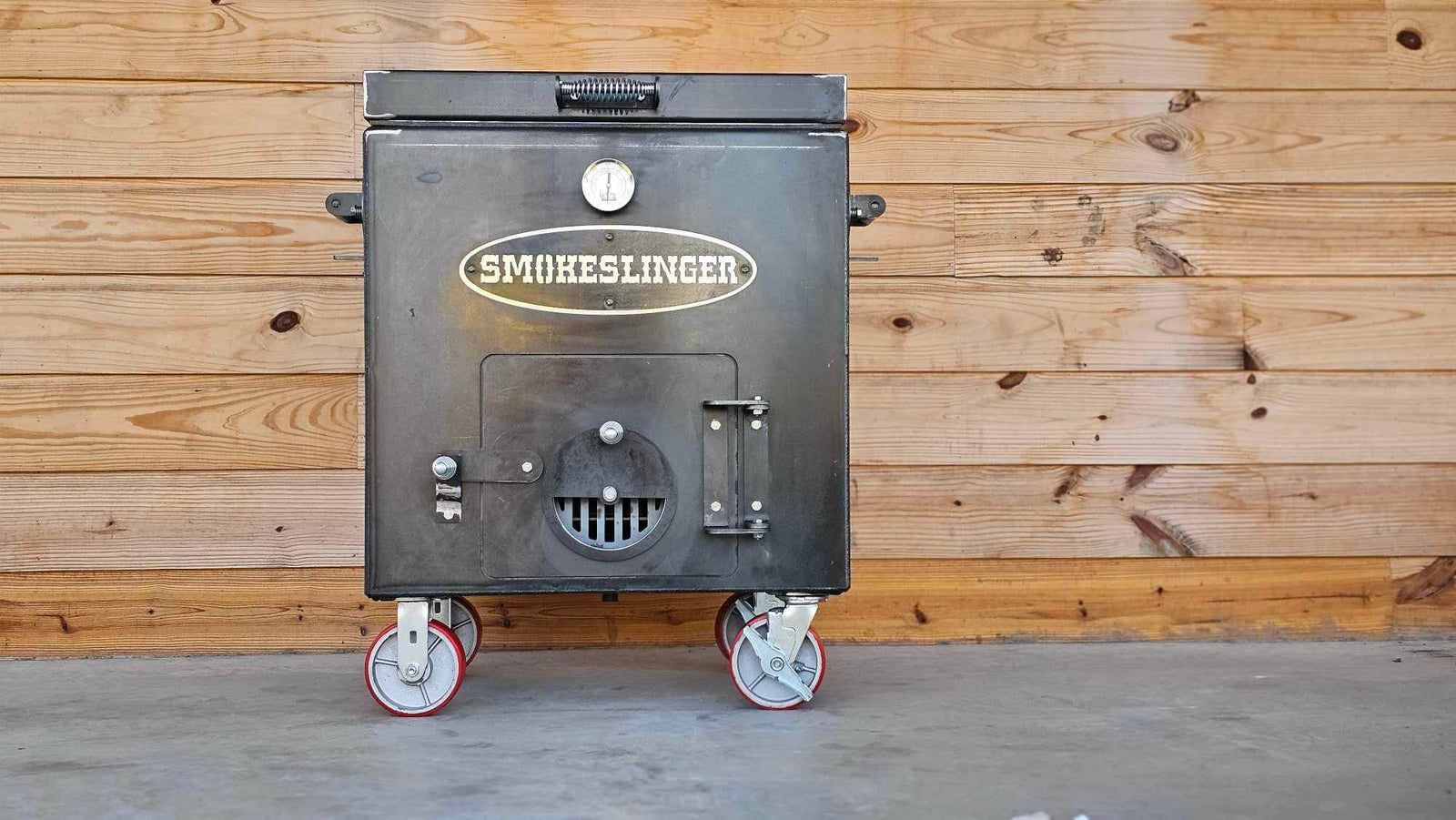

Slingshot vs. Mini: Which Compact Direct Heat Cooker Fits You?
The Slingshot and the Mini are our two compact direct heat cookers. Here's how the movable basket, the center drawer, searing, steel and price stack up, so you can pick the one that fits how you cook.

How To Use an EmberForge for Live Ember Cooking (Step-by-Step Guide)
Learn how to use the EmberForge to produce steady, controlled embers for direct heat cooking. This guide breaks down ember production, fire structure, and how to run a consistent ember rhythm for predictable results.

Smokeslinger Owner Spotlight: From Pellet Grill to Easy Direct Heat Cooking
Luc Barrette shares what it’s really like switching from a pellet grill to a Smokeslinger. No complicated process—just steady fire management, simple adjustments, and real results.