

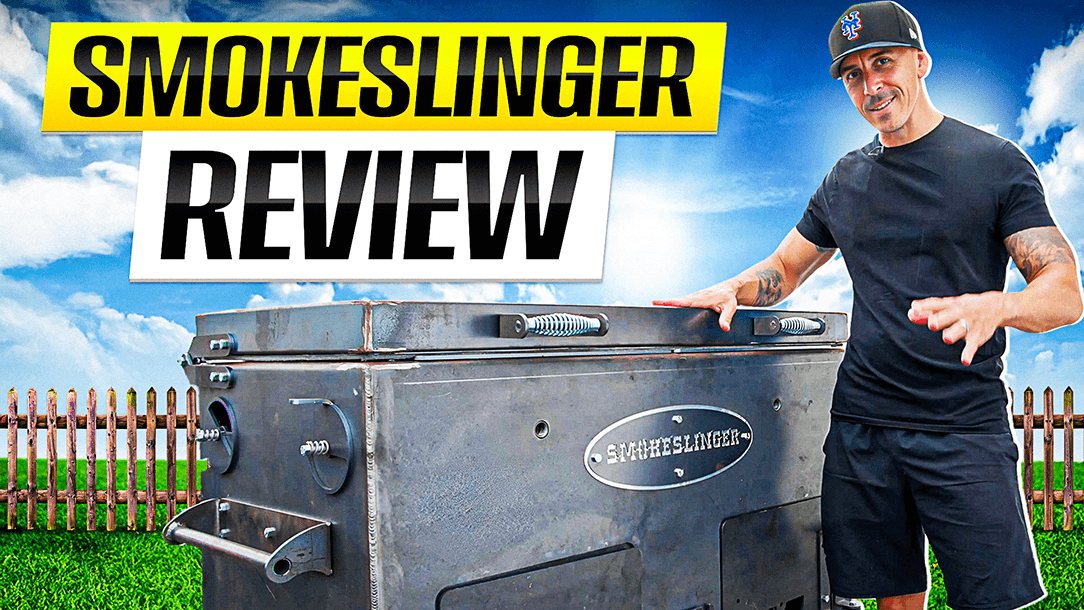

Hey pitmasters — I am excited about this Smokeslinger Full Size review because it spotlights an honest customer story. BBQ creator Allan Kiezel of FattyButts BBQ uncrated, set up, and seasoned his Full Size Smokeslinger with Planchas, then walked through the design in real time. You can watch more of Allan’s cooks on his FattyButts BBQ YouTube channel. If you want details on the cooker itself, see our Full Size Smokeslinger product page or request a quote.
Update, October 2026: the questions we hear most from owners and buyers are answered right below in Common questions, answered.
Watch: “The ONLY Grill/Smoker You Need! — Smokeslinger Direct Heat Grill Review” by Allan (FattyButts BBQ).
Common questions, answered
Between the questions buyers ask us and the ones owners ask in our Facebook group, the same few keep coming up. Here they are, answered straight, starting with the one people ask most.
Can a Smokeslinger hold 225°F?
Short answer: yes. Run a charcoal long-burn in offset or reverse flow mode, or a smaller wood fire with the insert pulled out of the drawer.
A common question is whether it only likes to run at 275 to 325. On a wood fire built on the insert, it does run hot, and that's by design. The insert raises the fire so air feeds it from underneath, which makes a hotter, more active fire. To run lower, you give the fire less air.
For a steady 225 to 250 on charcoal:
- Set up in offset or reverse flow mode. In offset mode, open fewer tuning plates over the fire for a lower-temp cook.
- Use a long-burn method instead of a full lit bed. Minion: fill the drawer with briquettes and light one corner. Snake: lay the charcoal in a narrow U along the drawer walls and light one end. Peg-leg: pull the insert, lay a wood split down the middle of the drawer, fill charcoal on both sides and dump a lit chimney at one end. Peg-leg runs about 5 to 6 hours at around 250 before you add fuel.
- Close the intake down and let it settle before you chase the number. Don't overfill the drawer if you want to stay under 300.
For 225 on wood: pull the insert so the fire sits lower with less air under it, keep the splits small (about 1.5 to 2 inches thick and 10 to 12 inches long), and stack them tight over the coal bed instead of a log-cabin stack.
Owners post 225 to 250 cooks in our group all the time: 12-hour pork butts, brisket in reverse flow, ribs for 6 hours. There is a learning curve. If your first long-burn runs hot, that's not failure, that's information: less air, a smaller light-off, and try again.
Full setups for every mode and method are in our direct heat smoker guide.
Is it hard to clean?
Short answer: no harder than any pit. Most owners who've run other cookers say the same.
The grease is the same grease any smoker makes. On direct heat cooks, a lot of the drippings burn off on the coals. On low-and-slow cooks in offset mode, a foil pan on the lower grate under the meat catches most of it before it reaches the floor.
The everyday clean is a quick recovery clean, not a deep clean:
- Pull the cooking grates and give them a quick brush.
- Scrape the tuning plates in place, sliding each one over to reach it.
- Pull the insert, slide the drawer back in, and scrape the floor into the drawer while the pit is still warm. A long-handled scraper or coal rake saves your knees.
- Liquid grease runs to the bottom drain, so set a pan under it. Keep ash and scrapings out of the drain hole.
- Empty the drawer and dispose of the ash and coals safely.
When buildup gets heavy, a deep clean is a power wash and a reseason (see seasoning below).
Will it rust if it lives outside?
Short answer: bare steel will surface-rust if you ignore it. Keep the outside oiled and cover it only when it's cold and dry.
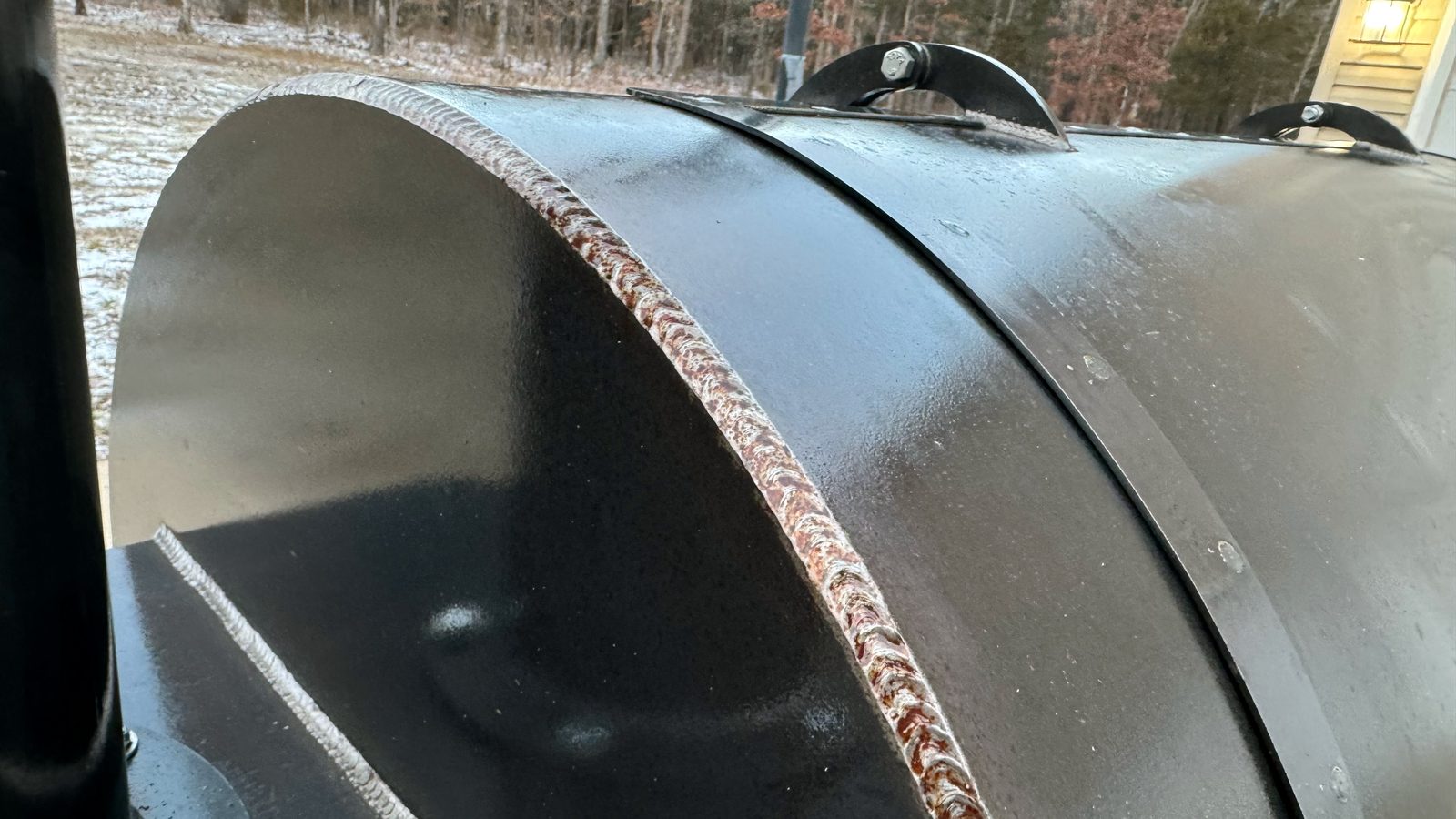
The body is ¼″ American steel with a mill-scale and boiled linseed oil finish, not paint. That finish is easy to maintain: a thin coat of boiled linseed oil on the outside every so often, wiped on with a microfiber towel, keeps water off and gives it that bronze patina.
- Cover it cold and dry only. A cover on a hot pit can melt. A cover on a wet pit traps moisture against the steel, and that's what causes rust, especially over damp concrete.
- After rain, pull the cover and let the pit air out before covering it again.
- Light surface rust blends back in with a stiff nylon brush and a fresh thin coat of oil.
Precision-fit covers are sold separately: see smoker accessories.
How does it do in cold weather?
Short answer: the insulated lid does most of the work. Expect to burn more fuel and give it longer to come up.
Heat rises, so the lid is where a pit loses the most in the cold. The Smokeslinger lid is two layers of steel with an air gap between them and a high-temp gasket around the edge, so the chamber holds its heat instead of bleeding it out the top. One owner in our group brought his up from 185 to 225 and held it with the temperature outside at 20°F.
Can it grill and sear hot?
Short answer: yes. For a hard sear, you bring the fire up to the food instead of lowering the food to the fire.
People see the grates sitting above the drawer and assume you can't get a real sear. On the Mini and Full Size, the super high heat setup fixes that: pull the insert out of the drawer, set it channel-side up on a few tuning plates, and build the charcoal right on it. The lower grate ends up about an inch above the coals. Stage the meat on the upper grate, then move it down to sear.
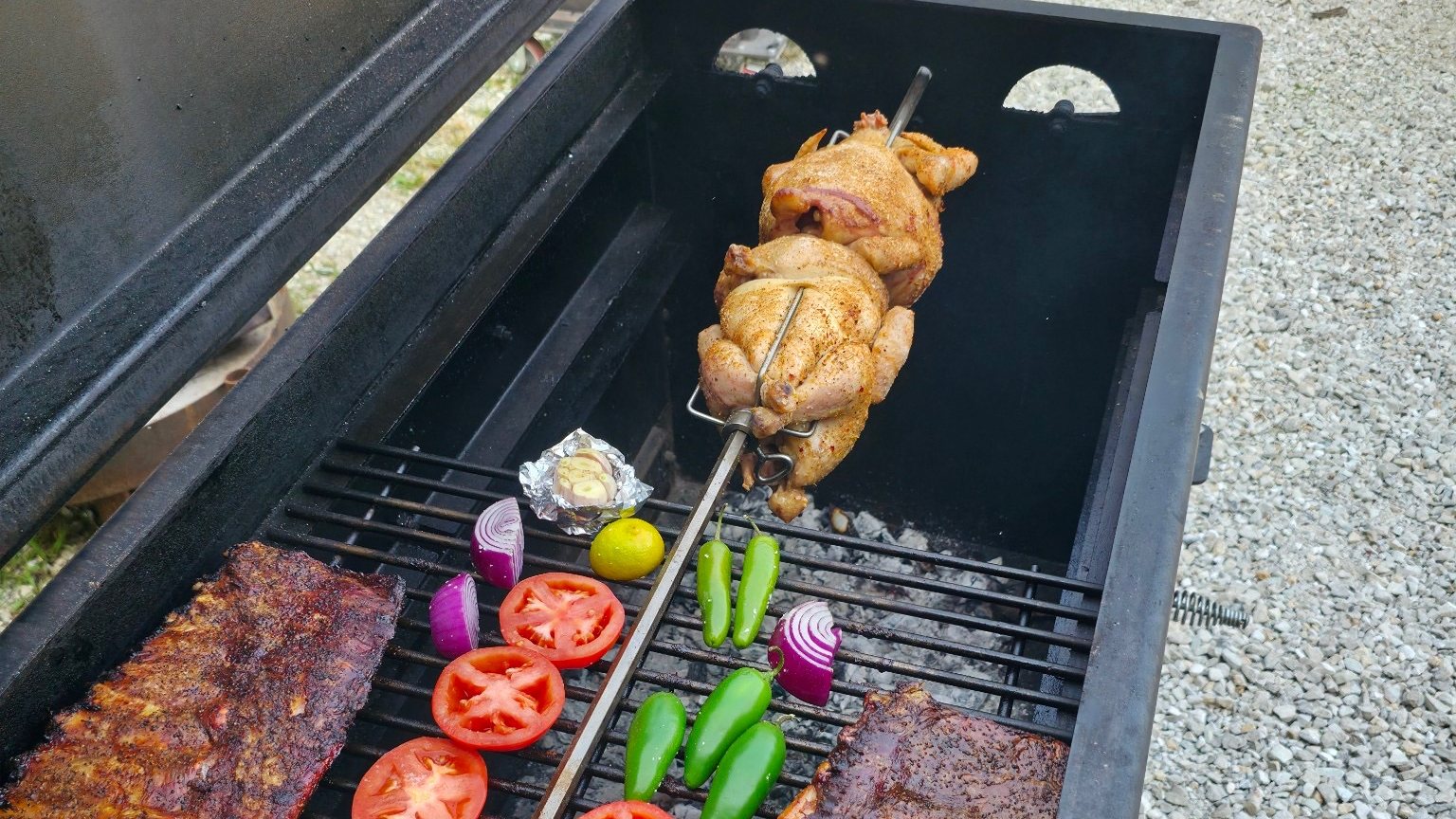
For steaks and chops you can also reverse sear: cook indirect on the far side in offset mode, then slide the meat over the open plate gap above the coals to finish. The optional plancha turns the same setups into a flat-top for smash burgers, fajitas and breakfast.
Do I need a fan controller to run it unattended?
Short answer: no. A long-burn charcoal setup will hold a steady low temperature for hours on its own.
The minion and peg-leg methods above are how owners run all-night and all-day cooks without standing over the pit. If you're coming from a pellet grill and already own a fan controller you like, our Fan Adapter Plate mounts to the firebox door intake with no tools and takes a standard 1″ pipe-thread fan. It's a convenience, not a requirement. Ask about it when you request a quote.
Will a whole turkey or ham fit?
Short answer: yes, on the Full Size. Whole birds and bone-in hams go on the lower rack. Spatchcocked turkey and carving hams fit on the top rack.
- Whole turkey: lower rack.
- Spatchcocked or frogged turkey: fits on the top rack fine.
- Bone-in hams (butt portion, shank portion or a whole ham): lower rack.
- Carving hams: fit on the top rack. A carving ham is a whole ham cut off along the bone, so it's whole muscle but boneless.
Why this Smokeslinger Full Size review matters
When a real customer walks through an unboxing and setup, you get the truth about design decisions. Allan’s commentary called the Smokeslinger a “Swiss Army knife,” and I agree — not because it tries to be everything, but because the core architecture makes direct heat grill, normal flow, and reverse flow smoker configurations feel natural. That is rare in one cooker.
Uncrating the Smokeslinger Pits Full Size
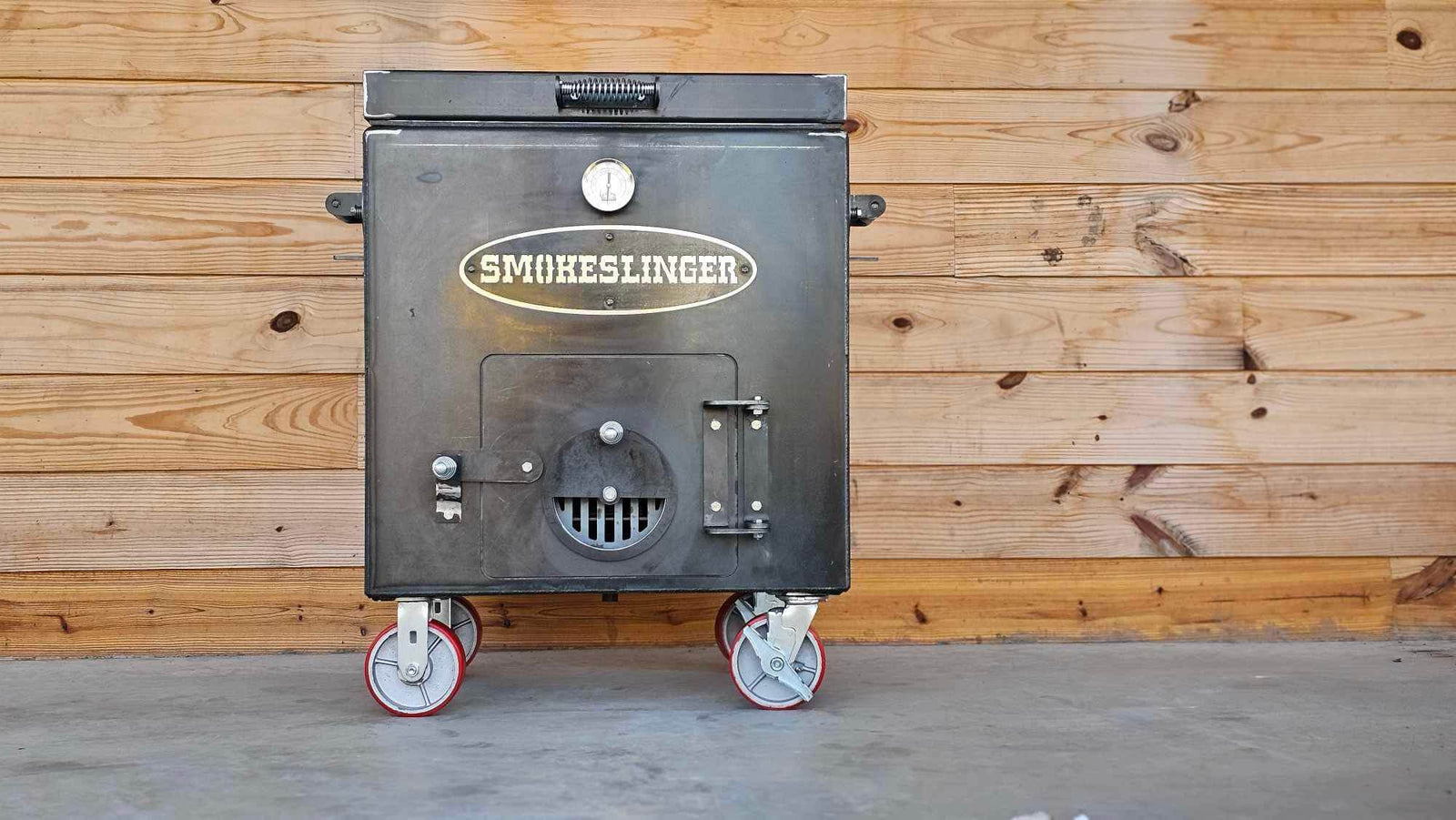
Allan showed a straightforward way to get the cooker off the shipping crate: remove the bracket bolts, lock the casters (two locking swivels in front, two straight in the back), and reinstall the bolts. He also installed the vents and door handles before rolling off to keep doors from bouncing.


Moving Your Smokeslinger Across Grass
For lawn travel, Allan laid down wood planks as track boards, then rolled the cooker along the path. With internals removed, the weight distribution improves and the move is controlled.

Planchas: Flat-top Cooking for the Smokeslinger
Allan’s unit included the optional Planchas (two pieces with their own drain ports), which turn the Smokeslinger into a flat-top for breakfast, smash burgers, or sauté work.

Bar Grates Upgrade for the Smokeslinger Full Size
The round bar cooking grates are now standard and included with all Smokeslinger smokers. They replace earlier mesh-style pieces and use the same grate size for both the top and bottom levels. That consistency makes swapping, cleaning, and rearranging straightforward while maintaining full cooking capacity on each shelf.

Baffle Plates & Heat Control: Direct Heat vs Offset and Reverse Flow Smoker
The Smokeslinger’s baffle plates let you switch easily between direct heat, reverse flow smoker, and direct heat vs offset configurations. Use the lower grate for delicate smokes if you want to minimize lid radiant heat.

Slide-Out Charcoal Baskets for Easy Refueling
The twin slide-out charcoal/wood baskets let you refuel without tearing down your grates and food. The included ash trays improve airflow and cleanup. Be sure the basket vent faces the front for proper intake.
Adjustable Side Vents for Airflow Control
Each side has adjustable vents. Open both for grill mode; close one set to force a reverse flow path; match them for even chamber flow.
How to Season a Smokeslinger Full Size
- Outside: Wipe with boiled linseed oil for quick polymerization and durable protection.
- Inside: Use a food-safe high-heat spray (e.g., avocado oil or PAM).
- Heat cycle: Bring the pit to about 400–450°F for a few hours to bake in the oil films. Handle linseed-oil rags safely.
Rag safety: oily rags can catch fire on their own if they're wadded up. Lay them out flat to dry, burn them in a fire pit, or soak them in water in a sealed bag. Never wad one into a trash can.
First-Cook Tips for the Smokeslinger
Try a reverse-sear steak to test both direct heat grill and indirect cooking modes in your first run.
Frequently Asked Questions
What makes this a true direct heat grill and a real smoker?
The baffle plates and dual baskets create distinct heat paths. Open for direct flame or close/redirect for smoker behavior.
How do I refuel mid-cook?
Slide a basket out, add fuel, slide back in. No grate teardown needed.
Do the Planchas replace a flat-top?
For most backyard cooks, yes — dual plates with drains give you full griddle capability.
Any tips for managing lid radiant heat?
Use the lower grate to increase headspace when smoking delicate items; save the top grate for rendering phases.
What oils should I use for seasoning?
Outside: boiled linseed oil (thin coats). Inside: food-safe high-heat spray. Bake at 400–450°F for several hours.
How big can the temperature split be side to side?
With smart venting and basket placement, over a hundred degrees of differential is possible depending on your configuration.
Final thoughts
Allan’s review shows the Smokeslinger Full Size is more than a novel idea — it is a practical, every-week cooker. If you want a pit that moves between direct heat grill, offset smoker and reverse flow smoker finesse, this one earns a hard look.
Explore specs and availability on the Full Size Smokeslinger product page or request a quote. Also visit FattyButtsBBQ.com and Allan’s YouTube channel for more cooks.
Keep your smoke thin and blue, and we will see you on the flip side!




Frank Cox
October 26, 2026
Greg, sorry this sat so long. Great question, and you’re comparing two solid pits. Here’s what I’d look at on the Full Size Smokeslinger:
- Two fire drawers, one at each end. Light one for a small cook or both when the family shows up, so you only burn what the cook needs.
- Nine sliding tuning plates. They let you run it as an offset, reverse flow, 90-minute hot and fast, or a hard sear with the fire an inch under the grate, all without buying add-ons.
- Both grate levels come in the box: four round-bar grates, 2,114 sq in.
- ¼″ American steel with a double-wall, air-gap insulated lid and a high-temp gasket. That lid is what holds a steady temp in cold and wind.
- Built in Kaufman, Texas, about 8 weeks from your down payment, and when you call, Frank or Lisa answers.
We put together a checklist you can hold any direct heat cooker to, ours included: https://smokeslinger.com/pages/direct-heat-cooker-buying-guide
Want to talk it through? Call or text 762-772-2727. You can also ask the owners in the Smokeslinger Pit Owners Group on Facebook. Several of them own both kinds of pits and will tell you straight.